.svg)


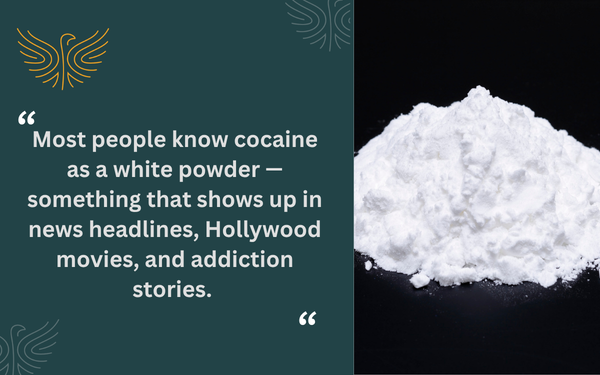
Most people know cocaine as a white powder — something that shows up in news headlines, Hollywood movies, and addiction stories.
But very few stop to ask what it actually is, where it comes from, or what goes into making it. And it’s not good. Keep reading to uncover where cocaine comes from and why no amount is safe to consume.
What is Cocaine?
Cocaine is a powerful stimulant drug classified as a Schedule II controlled substance in the United States, meaning it has a high potential for abuse and can lead to severe psychological and physical dependence.
In its most common form, cocaine appears as a fine white powder. It can be snorted, rubbed on the gums, or dissolved and injected. Crack cocaine, a processed, rock-like version of the drug, is smoked. Yet, no matter the form or method of use, cocaine is highly addictive and extremely dangerous.
Where Does Cocaine Come From?
Cocaine starts its life as the leaf of the Erythroxylum coca plant, a shrub that grows primarily in the mountain ranges and lowland jungles of South America. In fact, the coca plant is most commonly found in Colombia, Peru, and Bolivia. Colombia is by far the largest producer, though the coca plants grown in Bolivia and Peru tend to produce higher concentrations of cocaine alkaloids.
The coca leaf itself has been used for thousands of years by Indigenous communities in South America. These communities chewed for its mild stimulant effect, used in religious ceremonies, and valued for its ability to suppress hunger and altitude sickness. In other words, the plant itself is not inherently evil. So, how does the coca plant become cocaine?
What Is Cocaine Made From?
Getting from a coca leaf to the white powder sold on the street requires a multi-stage chemical process that involves some genuinely toxic substances. Here is how it works in plain terms.
It starts with the harvest. Coca leaves are picked by hand, often multiple times a year, depending on the climate and the species grown. Once harvested, the leaves are soaked in gasoline and other chemicals in large industrial drums to extract the coca base. This base is then drained, dried, and moved further along the production chain.
The next step is chemical refinement. The soaked leaves are treated with sulfuric acid, lime, potassium permanganate, and other substances depending on local methods and pricing. When dried, this mixture produces a crude paste, which is then transported to more sophisticated processing facilities.
At the next stage, the paste is soaked in acetone and acid, then drained again to create cocaine base, which is heated, dried, and pressed into brick form. These bricks are what move through the drug trafficking supply chain before being further refined into the cocaine hydrochloride powder that ends up on the street.
And yes, crack cocaine is made from this powder. Dealers mix powdered cocaine with water and baking soda, then heat the mixture until it hardens into a rock-like substance. As such, crack reaches the brain more quickly than powder cocaine, producing a more intense high and carrying an even greater potential for addiction.
By the time cocaine reaches the end user, it has almost certainly been mixed with other substances. Street-level cocaine can be as little as 20% pure cocaine, with the rest made up of fillers added to increase volume and profit. These additives range from harmless (such as baby aspirin or cornstarch) to deadly (including levamisole, a livestock deworming drug, and increasingly, fentanyl).
Why Are the Ingredients So Dangerous?
The chemicals used to produce cocaine actually leave traces behind. Residue from gasoline used in the extraction process can be found in finished cocaine, and traces of cement used to separate alkaloids from the leaves sometimes appear in poorly refined batches. But ultimately, the end user has no way of knowing what is in what they are taking.
The cutting agents add another layer of unpredictability. Levamisole, one of the most common additives, has been linked to severe immune system damage. Fentanyl, which is now found in a growing share of the cocaine supply, is lethal in microscopic amounts.
As such, someone who has used cocaine before and believes they know their limits has no defense against an unknown dose of fentanyl hidden inside their usual amount. There is no such thing as clean street cocaine—and assuming otherwise is a gamble with life-or-death.
How Does Cocaine Addiction Happen?
Cocaine addiction develops because the drug hijacks the brain’s reward system in a way that feels nearly impossible to resist. Every time someone uses cocaine, the brain is flooded with dopamine far beyond what any natural experience produces. Over time, the brain starts to rely on that artificial flood and loses its ability to generate normal feelings of pleasure without the drug.
The signs of cocaine addiction tend to show up across every area of a person’s life. Physically, users may experience frequent nosebleeds, rapid weight loss, disrupted sleep, and declining overall health. Behaviorally, addiction often looks like increased secrecy, pulling away from family and friends, financial trouble, and an inability to keep up with responsibilities.
Psychologically, cocaine addiction can cause intense mood swings, paranoia, anxiety, and deep irritability, especially when someone is unable to use or is coming down from a high.
Getting Help With Freedom Recovery Centers
If you or someone you love is caught in the cycle of cocaine use, Freedom Recovery Centers (FRC) is here to help. We know that reaching out takes courage, and we take that seriously. Each treatment is tailored to the individual, ensuring you get the help and treatment you need.
Call us at 804-635-3746 or fill out our online form. Whenever you’re ready, we’re here for you.

.svg)


.svg)


.svg)