.svg)





Cocaine is a powerful and highly addictive stimulant. It’s devastated communities and claimed countless lives. But its story didn’t start here. Surprisingly, it began thousands of years ago in the Andes mountains in South America.
Where Does Cocaine Originally Come From?
Cocaine is derived from the coca plant, which is native to South America. These plants grow naturally at high altitudes in countries such as Bolivia, Peru, and Colombia.
Long before cocaine was ever synthesized in a lab, indigenous communities chewed coca leaves to suppress appetite, ease fatigue, and cope with the physical demands of working at high elevations. In fact, the raw coca leaf doesn’t contain nearly as close to many stimulant effects as cocaine.
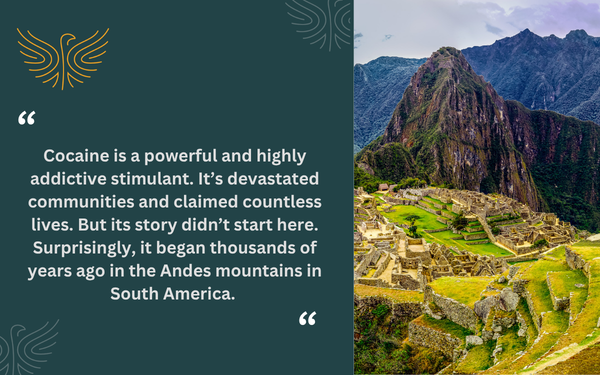
When European explorers arrived in the Americas in the late 1400s and 1500s, they encountered indigenous peoples chewing the coca leaf. The Spanish initially disapproved of the practice, but quickly changed their position once they realized coca helped their enslaved laborers work longer with less food and rest, particularly in the brutal high-altitude silver mines. So, they legalized it, taxed it, and even used the proceeds to fund the Catholic Church.
However, for centuries, coca remained largely confined to South America, meaning there wasn’t widespread use of it for hundreds of years.
When Was Cocaine Actually Discovered?
Technically, cocaine was discovered in 1859 when German chemist Albert Niemann successfully isolated the active alkaloid from coca leaves and named it cocaine.
He observed that the compound had a bitter taste, promoted saliva, and produced a peculiar numbing and cold sensation (something that became useful in the medical field).
Yet, Niemann died in 1861, but his student Wilhelm Lossen continued the work, determining cocaine’s correct chemical formula by 1865. This was a turning point where cocaine became a concentrated, isolatable compound, ultimately, changing everything.
The Evolution of Cocaine
In the decades that followed, cocaine was embraced by the medical community and the public alike. In 1863, Corsican chemist Angelo Mariani created Vin Mariani, a cocaine-infused Bordeaux wine marketed as a health tonic. It actually became a worldwide sensation, endorsed by figures ranging from Pope Leo XIII and Thomas Edison to Ulysses S. Grant. Cocaine also found its way into hay fever remedies, and inspired early versions of Coca-Cola.
Scientifically, real progress was being made. In 1880, physiologist Vassily von Anrep published research suggesting cocaine’s potential for surgical use. Then in 1884, Vienna hospital intern Carl Koller made a landmark discovery; cocaine could numb the surface of the eye, making it viable as a local anesthetic in eye surgery and opening an entirely new era in medicine. That same year, American surgeons William Halsted and Richard Hall developed nerve-blocking techniques using cocaine injections, laying the groundwork for modern regional anesthesia.
The medical advances were fascinating, but the dangers were already beginning to surface. Halsted himself became addicted to cocaine within months of his landmark work, and was only able to break the dependency by turning to morphine. In other words, the warning signs were there; they were simply ignored.
When Did Cocaine Become a Controlled Substance?
By the late 1800s, the first serious reports of harm from cocaine were impossible to ignore. Physicians began documenting addiction, psychological deterioration, and dangerous physical effects in patients. Public alarm then grew, though much of it was driven not just by genuine health concerns but by racist narratives that falsely linked cocaine use to crime by Black men, and that would heavily shape the legislation to come.
Coca-Cola quietly removed cocaine from its formula around 1903. The Pure Food and Drug Act of 1906 required manufacturers to label cocaine-containing products, which caused a significant drop in their use.
However, the Harrison Narcotics Tax Act of 1914 placed strict federal controls on cocaine and opiates together.
From there, cocaine use declined through the mid-20th century. By the 1950s, cocaine was barely on law enforcement’s radar. Yet, it made a resurgence in the 1960s and 1970s, primarily as a powder among wealthier users. Then in the 1980s, a cheaper smokable form—crack cocaine—emerged and spread rapidly through lower-income communities, causing a devastating and distinctly different epidemic.
Today, cocaine is a Schedule II controlled substance. This means it has tightly limited medical uses but no legal path for recreational use.
Cocaine Use and Addiction Today
So, how does cocaine work exactly? What happens in the body leading to addiction?
Essentially, cocaine causes an increased release of dopamine in the brain, producing an intense but short-lived high. The crash that follows is sharp, and the craving for more sets in quickly. Over time, the brain adjusts, requiring more cocaine just to feel normal. This cycle (use, crash, crave) is what drives cocaine addiction.
It’s also worth noting that many people who struggle with cocaine use are managing other co-occurring conditions, such as anxiety, depression, trauma, or PTSD. Unfortunately, many people fall into the trap of using substances, like cocaine, to cope with these mental health issues. However, this is also exactly why proper treatment can be so effective.
Getting Help for Cocaine Addiction
Cocaine addiction is a medical condition, and it is treatable.
At Freedom Recovery Centers (FRC), we offer compassionate care for substance use disorders, including cocaine addiction. Our team specializes in dual diagnosis care, meaning we treat mental health conditions such as anxiety, depression, and PTSD alongside addiction. This ensures we get to the root cause of what’s going on. If you or someone you love is struggling, please reach out. Call us today at 804-635-3746. Recovery is possible, and it starts with one step.

.svg)


.svg)


.svg)