.svg)


.png)


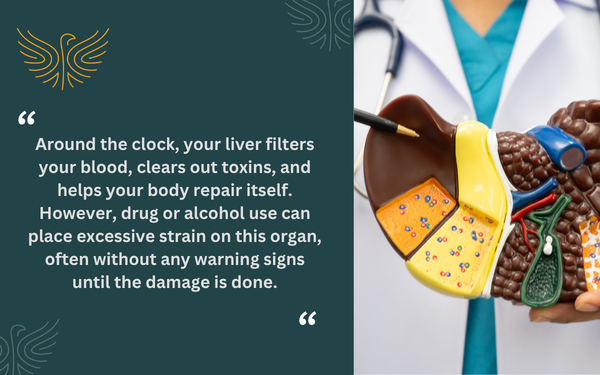
Around the clock, your liver filters your blood, clears out toxins, and helps your body repair itself. However, drug or alcohol use can place excessive strain on this organ, often without any warning signs until the damage is done.
Maybe you’re worried about yourself or a loved one. Here’s some good news: The liver is one of the most forgiving organs. It also has incredible regenerative abilities. This means that sometimes, the harm caused by addiction may be slower, stopped, or even reversed—once the substance use itself stops.
With that in mind, here’s exactly how addiction impacts the liver.
1. Fat Begins to Build Up in the Liver
When your liver is busy processing alcohol or other substances, breaking down fat slips to the bottom of its to-do list. And this means that fat starts to build up inside this organ.
This stage, called fatty liver, usually causes no symptoms, which is exactly why it so often goes unnoticed. The hopeful part is that fatty liver is frequently reversible, and for many people, it begins to improve once the drinking or drug use stops.
2. The Liver Becomes Inflamed
As your liver works to break down alcohol and drugs, it creates toxic byproducts that irritate and inflame its own tissue. As time goes on, this inflammation may develop into hepatitis.
Interestingly, some individuals feel nothing in the early stages, while others may notice nausea, deep fatigue, pain in the upper right side of the abdomen, or a yellowing of the skin and eyes known as jaundice. When inflammation becomes severe, it can progress quickly—which is why these symptoms are always worth taking seriously.
3. Scar Tissue Forms (Fibrosis and Cirrhosis)
When the liver is injured repeatedly, it does its best to heal by laying down scar tissue. Little by little, that scarring (called fibrosis) replaces healthy tissue.
If it keeps progressing, it can become cirrhosis, which is a severe, permanent scarring that stops the liver from doing its job properly. Cirrhosis is one of the hardest consequences of long-term addiction, and a reason that some individuals end up needing a liver transplant.
4. The Risk of Viral Hepatitis Goes Up
When drug use involves needles—especially shared ones—the risk of hepatitis B and hepatitis C increases sharply. These infections are among the biggest causes of long-term liver damage in the world, and they may cause harm for years before anyone notices.
However, testing for hepatitis is simple, and treatment has come a long way. In other words, there’s hope and available treatment if it’s caught early enough.
5. Sudden, Serious Liver Damage May Happen
While rare, cocaine, especially during an overdose, may reduce or limit the blood and oxygen the liver needs, causing its cells to die rapidly.
Mixing alcohol with acetaminophen—the pain reliever found in many over-the-counter and prescription medications—is another combination that can overwhelm the liver and become life-threatening.
If you ever suspect an overdose or poisoning, treat it as a medical emergency and call 911 right away.
6. The Risk of Liver Cancer Climbs
Years of inflammation and scarring slowly change the liver at the cellular level. Over time, this raises the risk of liver cancer. Smoking also adds to the danger, since the chemicals in cigarette smoke may injure the liver too.
At the end of the day, it’s essential to address the underlying causes, including substance use, to reduce this risk.
7. Mixing Substances Makes It Worse
Using more than one substance at a time (polysubstance use) also burdens the liver. On top of this, different substances can interact in unpredictable ways, compounding the strain and making it harder for the body to bounce back. Together, they often do far more damage than any one of them would on its own.
There’s Hope: Your Liver Can Heal
The liver is extraordinarily resilient. It’s one of the only organs in the body that can truly regenerate itself. When substance use stops and the body gets the right support, early damage can improve—and in many cases, heal completely. The sooner the root cause is addressed, the more of your health you can protect.
At Freedom Recovery Centers (FRC), our team is here to help you take that first step toward a healthier liver and a fuller life. Our caring, compassionate team will walk beside you every step of the way. Call us today at 804-635-3746.

.svg)


.svg)


.svg)