.svg)





Individual therapy is a private, one-on-one conversation between you and a licensed therapist, revolving around the specific thoughts, triggers, and experiences driving your substance use. This is where the real work of recovery happens.
But it can be nerve-racking, especially if you’ve never done individual therapy before. So, here’s what actually happens during an individual therapy session.
What is Individual Therapy in Addiction Treatment?
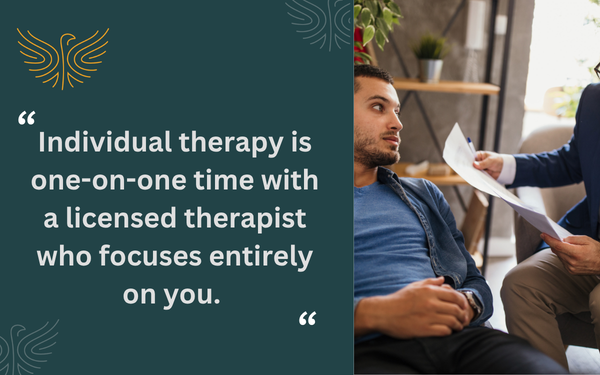
Individual therapy is one-on-one time with a licensed therapist who focuses entirely on you1. Unlike group therapy, where you share space and time with peers, individual sessions give you undivided attention and room to move at your own pace.
Many individuals who struggle with substances are also experiencing anxiety, depression, PTSD, or unresolved trauma. And these can be hard to unpack in a group setting.2 8
In a one-on-one setting, your therapist can explore the why behind your substance use and treat both your addiction and your mental health at the same time (an approach known as dual-diagnosis care)3. Within these sessions, your therapist may use Cognitive Behavioral Therapy (CBD), Dialectical Behavioral Therapy (DBT),5 and other techniques to help address your thought patterns and triggers4.
Your First Session
Your first session is mostly about getting to know each other6. Your therapist will ask about your history, including your substance use, your background, your relationships, and what brought you to treatment. There may be some paperwork and a few assessments, which is why first sessions often run a little longer than the ones that follow.
And if you’re not sure what to say, that’s okay; your therapist will guide the conversation with questions. It’s also normal to feel nervous, guarded, or even a little emotional. And you’re not expected to share your whole story in one sitting. This first meeting is simply the beginning of a relationship built on trust and ongoing rapport.
Ongoing Sessions
Ongoing sessions typically begin with a check in, such as how your week went, how you are sleeping, and whether cravings or difficult emotions have come up. From there, you and your therapist might dig into a specific pattern or trigger, such as stress, certain people, or places that pull you toward using.
Together, you will work on practical coping skills you can actually use in real life settings, and you may set a small goal to focus on before your next session7.
How Long Is a Session? And How Often Will I Have Them?
Most individual therapy sessions last somewhere between 45 and 60 minutes. Early in treatment, you can expect to meet regularly—often weekly, and sometimes more frequently—since consistency is what builds trust and keeps your recovery moving forward. Your exact schedule is likely to be determined by your individual treatment plan and your needs.
Curious to Learn More?
At Freedom Recovery Centers (FRC), individual therapy is one piece a much broader treatment approach. Our residential program in Richmond, VA pairs one-on-one sessions with group therapy, medically supervised detox, and other therapies and activities, all built around your individual treatment plan and your goals.
At the end of the day, recovery is possible. And sometimes, that first step can feel like the hardest part. At FRC, we’re not here to judge. We’re here to listen and help you determine your next step. Call us at 804-635-3746 when you’re ready; our phone lines are open 24/7.

.svg)


.svg)


.svg)

