
Cookie Settings
close

September 8, 2026

What is Outpatient Rehab?

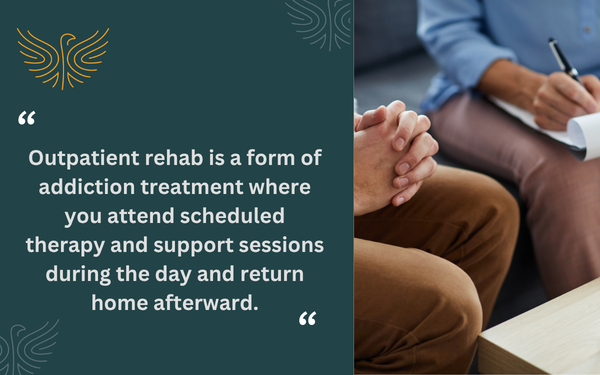
Outpatient rehab is a form of addiction treatment where you attend scheduled therapy and support sessions during the day and return home afterward.

It gives you access to real, evidence-based care - individual counseling, group therapy, relapse-prevention work¹ - while you keep up with the parts of your life that can’t be put on pause during your recovery, such as work, school, and family.²
For many people, this flexibility makes all the difference. But ultimately, the right level of care depends on where you are in your journey. ³

Key Takeaways
  • Outpatient rehab lets you attend scheduled treatment sessions and return home afterward, making it possible to continue with work, school, and family responsibilities.
  • Outpatient programs vary in intensity, from standard outpatient programs (OP) to intensive outpatient programs (IOP) and partial hospitalization programs (PHP).
  • Treatment may include individual counseling, group therapy, relapse-prevention planning, evidence-based therapies, medication-assisted treatment, and dual diagnosis care when appropriate.
  • Outpatient care tends to work best when you have a stable home environment and do not require 24/7 supervision.
  • Severe addiction, acute withdrawal, or an unsafe home environment may indicate that detox, residential treatment, or another higher level of care is needed first.
  • Recovery needs can change over time, so people may move between different levels of treatment as they progress.

How Outpatient Rehab Works

Outpatient rehab is built around structure. You attend treatment on set days and times each week, then go home when your sessions are done. Those sessions typically include a mix of individual therapy, group counseling, education about addiction and recovery, and practical relapse-prevention planning. ²

Instead of stepping away from your daily life entirely, you take the skills you learn in the morning and apply them that same afternoon - at home, at work, in the relationships and situations that matter to you. Session frequency, however, varies widely, from a few hours a week to several days a week, depending on your needs and how far along you are.

For those who need round-the-clock support, residential treatment may be a better starting point. But for many, outpatient care offers the right balance of support and independence. ³

Types of Outpatient Programs

Not all outpatient rehab looks the same. Programs are offered at different levels of intensity, so you can find one that matches where you are right now. ³

Standard Outpatient Program (OP)

This is the least intensive level, usually a few hours of treatment per week. Standard outpatient works well for milder cases or as a step-down for someone who has already completed a higher level of care and wants ongoing support as they settle back into everyday life.

Intensive Outpatient Program (IOP)

An IOP involves more hours and more structure, often several sessions a week for a few hours each. It’s a strong middle ground for people who need meaningful, consistent treatment but don’t require 24/7 supervision.

Partial Hospitalization Program (PHP)

A PHP is the most intensive outpatient option, with treatment nearly every day for several hours. The hours look a lot like inpatient care, but you sleep in your own bed at night. It's often used for people who need substantial support but have a stable, safe place to return home to.

It’s also worth noting that recovery isn’t usually linear, and neither is treatment. It’s common to move between these levels over time as you grow stronger.

Program Typical Intensity How It Works Who It May Be Best For
Standard Outpatient Program (OP) Least intensive; usually a few hours of treatment per week Provides ongoing therapy and support while allowing you to maintain your everyday routine. People with milder needs or those stepping down after completing a higher level of care.
Intensive Outpatient Program (IOP) More intensive; often several sessions per week for a few hours at a time Offers more structure and consistent treatment without requiring 24/7 supervision. People who need meaningful, consistent support but do not require round-the-clock care.
Partial Hospitalization Program (PHP) Most intensive outpatient option; treatment nearly every day for several hours Provides a schedule similar to inpatient treatment while allowing you to return home at night. People who need substantial support and have a stable, safe home environment.

What Happens in Outpatient Treatment

Generally, you’ll work with clinicians using proven, evidence-based approaches such as cognitive-behavioral therapy (CBT), dialectical behavior therapy (DBT), trauma-informed care, and motivational interviewing. Group therapy also plays a big role, giving you a chance to connect with others who understand what you’re going through. ²

For some people, medication is part of their plan (it varies from person to person). Medication-assisted treatment may help ease withdrawal symptoms and reduce cravings, making the day-to-day work of recovery more manageable.

Addiction rarely travels alone, either. If you’re also living with a condition such as anxiety, depression, or PTSD, dual diagnosis treatment addresses both at the same time.

Is Outpatient Rehab Right for You?

Outpatient rehab tends to work best when a few things are in place, including a stable and supportive home environment, a mild-to-moderate addiction, or strong outside commitments you need to keep. It’s also an excellent step-down option after completing inpatient care or detox, helping you stay supported as you transition back into daily life.

Yet, outpatient care isn’t the right first step for everyone. If you’re facing a severe addiction, an unsafe or unstable home situation, or acute withdrawal, a higher level of care is usually needed first. In many cases, that means beginning with medically supervised detox or residential treatment before stepping down to outpatient support once you’re stable. ³

There’s no shame in needing more support at the start. What matters is matching the level of care to each person. ³

Situation When Outpatient Rehab May Fit When a Higher Level of Care May Be Needed First
Home Environment You have a stable and supportive place to return to after treatment sessions. Your home environment is unsafe or unstable.
Addiction Severity Outpatient treatment tends to be better suited to mild-to-moderate addiction. A severe addiction may require more intensive support before transitioning to outpatient care.
Withdrawal You are stable enough to participate in scheduled outpatient treatment. Acute withdrawal may require medically supervised detox or another higher level of care first.
Daily Responsibilities You need to maintain responsibilities such as work, school, or family while receiving treatment. Your needs require more intensive or round-the-clock support.
Stage of Recovery You are transitioning from inpatient care or detox and need continued support as you return to daily life. You are not yet stable enough to safely step down to outpatient treatment.

We’re Here When You’re Ready

At Freedom Recovery Centers (FRC) in Richmond, VA, our team is here to help you figure out what’s best for you. Our phone lines are open 24/7, and every conversation is confidential and pressure-free. Call us anytime at 804-635-3746 to talk through your options and determine what’s best for you or a loved one. ¹⁰

Frequently Asked Questions
Do you live at an outpatient rehab?

No. With outpatient rehab, you attend scheduled treatment sessions and return home when your sessions are finished.

What is the difference between OP, IOP, and PHP?

The primary difference is the level of intensity and structure. Standard outpatient (OP) is the least intensive, intensive outpatient (IOP) provides more frequent treatment, and partial hospitalization (PHP) is the most intensive outpatient option described here.

Can I work or go to school while attending outpatient rehab?

Outpatient rehab is designed to allow people to receive treatment while continuing important parts of daily life, including work, school, and family responsibilities.

What therapies are used in outpatient rehab?

Treatment may include individual and group therapy as well as evidence-based approaches such as cognitive-behavioral therapy (CBT), dialectical behavior therapy (DBT), trauma-informed care, and motivational interviewing.

Can outpatient rehab include medication?

For some people, medication-assisted treatment may be included to help ease withdrawal symptoms and reduce cravings. Treatment plans vary based on individual needs.

When might outpatient rehab not be the right first step?

Someone experiencing severe addiction, acute withdrawal, or an unsafe or unstable home environment may need a higher level of care, such as medically supervised detox or residential treatment, before transitioning to outpatient support.

Reviewed

Medically and professionally reviewed by Freedom Recovery Center

Are you ready to live free?

We're here for you 24/7. Call us and we’ll take care of you.

804-635-3746
"Getting sober was the single bravest thing I've ever done and will ever do in my life”
Jamie Lee Curtis
“I finally summoned up the courage to say the three words that would change my life: 'I need help'"
- Elton John

Are you ready to live free?

You don't have to see the whole staircase. Just take the first step at FRC.