.svg)




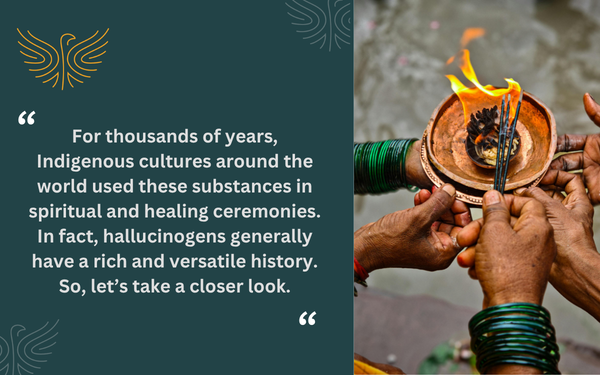
For thousands of years, Indigenous cultures around the world used these substances in spiritual and healing ceremonies. In fact, hallucinogens generally have a rich and versatile history. So, let’s take a closer look.
What Is the History of Hallucinogens?
Some archaeological evidence suggests humans were using them as far back as 8,000 to 10,000 BCE. Cave paintings in Spain and Algeria depict mushroom-like figures from prehistoric times, and Indigenous cultures across the Americas, Africa, and Asia have long traditions of using plants and fungi for spiritual, medicinal, and ceremonial purposes.
In the Amazon basin, communities developed ayahuasca brews. In the deserts of North America, Indigenous peoples used peyote in religious ceremonies that continue today.
Western discovery came much later.
When Spanish conquistadors arrived in the Americas in the 16th century, they documented Indigenous use of these substances and then tried to suppress it. For centuries, hallucinogens remained largely outside European scientific knowledge.
But this changed in the 19th century, when chemists began isolating active compounds. The 20th century brought lab-synthesized hallucinogens, such as LSD and DMT. The 1960s counterculture pushed these substances into mainstream awareness, and today, researchers are once again studying hallucinogens for potential mental health applications, such as treatment-resistant depression and PTSD.
Common Hallucinogens and Their Discovery
So, when exactly were some of the most common hallucinogens “discovered”?
Psilocybin Mushrooms
Psilocybin mushrooms have been used in Mesoamerican religious ceremonies for thousands of years. The Aztecs revered them as sacred, and the Mazatec people of Oaxaca, Mexico, still use them in healing rituals.
The Western world only learned about them in 1957, when American R. Gordon Wasson published an article in Life magazine describing his experience with a Mazatec healer named María Sabina. One year later, in 1958, Swiss chemist Albert Hofmann isolated and identified psilocybin as the active compound.
Peyote and Mescaline
Peyote use among Indigenous peoples of Mexico and the southwestern United States goes back at least 5,500 years, making it one of the oldest documented hallucinogens in human history. The cactus continues to play a sacred role in the Native American Church today.
In 1896, German chemist Arthur Heffter isolated mescaline from peyote, making it the first hallucinogen ever extracted in pure form.
LSD
LSD has one of the most famous origin stories in modern chemistry. In 1938, Swiss chemist Albert Hofmann synthesized it while researching ergot, a fungus that grows on rye. But he put it off to the side for about five years.
Then, in 1943, Hofmann accidentally absorbed a small amount through his skin and experienced its psychoactive effects. A few days later, he intentionally took a larger dose and rode his bicycle home, which is an event now commemorated annually as Bicycle Day on April 19.
DMT
DMT was first synthesized in 1931 by Canadian chemist Richard Manske, but its psychoactive properties weren’t recognized at the time. This didn’t come in 1956, when Hungarian chemist Stephen Szara self-experimented with the compound and identified its powerful hallucinogenic effects.
DMT has since been found to occur naturally in many plants and even in trace amounts in the human body.
Ayahuasca
Ayahuasca has been brewed by Amazonian Indigenous peoples for centuries, possibly much longer. Western explorers first documented it in the 1850s, and researchers spent the 20th century studying its active compounds.
In recent decades, ayahuasca ceremonies have spread far beyond the Amazon, becoming part of a global interest in plant medicines.
PCP and Ketamine
PCP was synthesized in 1956 as a surgical anesthetic but was pulled from human use within a few years due to severe side effects, including agitation and delusions. Meanwhile, ketamine was developed in 1962 as a safer alternative and is still used medically today, including, under strict supervision, as a treatment for depression and chronic pain.
Both substances eventually made their way to the street, where their dissociative effects are often unpredictable and dangerous.
Salvia Divinorum
Salvia divinorum has been used by the Mazatec people of Oaxaca, Mexico, for centuries in healing and divination rituals. Western researchers first documented the plant in 1939, but its active compound (salvinorin A) wasn’t isolated until 1982.
Can You Become Addicted to Hallucinogens?
Most hallucinogens don’t cause physical dependence the way opioids or alcohol do. You generally won’t experience the kind of withdrawal symptoms associated with those substances.
But that doesn’t mean hallucinogens are safe to use repeatedly.
Psychological dependence is very real. You can develop a pattern of compulsive use, especially when you’re using hallucinogens to numb other issues, such as anxiety, depression, trauma, or unresolved pain.
Hallucinogens may also worsen mental health conditions. Some people experience drug-induced psychosis or hallucinogen-persisting perception disorder (HPPD). And when hallucinogens are mixed with other substances (or laced with something dangerous, such as fentanyl), the risks significantly increase.
At Freedom Recovery Centers (FRC), our team is here to help you pave your way toward recovery. You don’t need to do it alone, nor do you need to hit rock bottom before getting help. Call us today at 804-635-3746 or fill out our online form.

.svg)


.svg)


.svg)